|
 Tauromenium, to avoid the destructions and sacks which Syracuse suffered, started a friendly politics with Rome and, in 212 BC, it submitted to the capital city. Tauromenium, to avoid the destructions and sacks which Syracuse suffered, started a friendly politics with Rome and, in 212 BC, it submitted to the capital city.
This action determined in Sicily the end of the greek civilization's period of maximum splendor. Caesar Octavian made of Taormina a Roman colony, removing many of its inhabitants and populating it with Roman families. Attracted by the beauty and mild climate, many consuls retiring to private life chose it as place where rest. Many famous Roman families built luxurious villas in the most pleasant or close to the sea places to reside there permanently. Spisone place took its name from Pisones's family and Calpurnia's people. Via Jalia Bassia took its name from the matron Julia Basilia. Mufabi region took its name from the villa built by the Fabi's family.
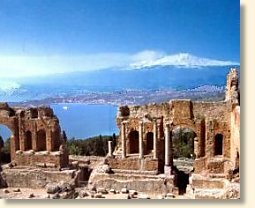
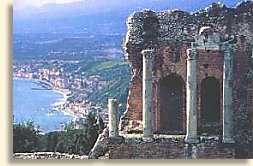
Having submitted at once to Rome, Tauromenium was the first free and federate civitas among the 52 cities in the island. Thanks to this recognition it was exempted from the tributes towards Rome and many privileges were granted to Tauromeniti, the Roman citizenship inclusive. The town enjoyed a period of peace up to 133 BC, during which Geron II ordered the restructuration of the Greek Theater (that's why today the ancient Theater is often called Greek-Roman), tthe costruction of new monuments and he gave also an impulse to the urbanistic development.
In the same period the struggle for supremacy and existence developed between Rome and Carthage; struggle which lasted 120 years (264-146 BC) and that ended with the destruction of Carthage, in 146 BC, after the three Punic Wars. The definitive expulsion of the carthaginians from the island is due to the Romans, but Sicily and Tauromenium didn't ever become Latin. Tauromenium preserved, in fact, its Greek speaking up to the birth of the vernacular in the Norman-Swabian period. A proof of that stays in the fact that the bishop Teòfono Cerameo pronounced his homilies still in Greek.
The Roman empire's history embraces five centuries, from 31 BC. to 476 AD. This historical phase is characterized by crisis and disorders, civic struggles, social transformations. Limiting the attention to Sicily, we notice that the inexorable decadence continued in all the fields and for a long time misgovernment reigned in the island. The rural ownership tended to disappear, cause it was ill-treated by the fiscal increases. The agrarian zones of the island became prey for the italic speculators and the number of disinherited people increased.
Such impoverishment, determined by more and more greedy impositions, exasperated the agriculturists, who rebelled against Rome. The revolts, which established an awakening of the island independence's feelings, were called the revolts of the slaves (135-132 and 104-101 BC). Born in Sicily and fed in Rome by the work of the people's tribune, the Tiberio and Caio Gracco brothers, revolts involved Tauromenium too.
 Dozens of thousands of farmers and slaves, leaded by Euno, rose up against the landowners and occupied Enna, Agrigento, Catania and Tauromenium (a monument in Enna remembers the heroism of Euno). Rome sent the consul Fulvio Flacco with the order to tame rebels. He besieged Tauromenium and as he didn't succeed in occupying it the consuls Lucio Pisone and Publio Rupilio came to his help (two streets of Taormina remember these two consuls up to now, but nothing remembers, instead, the epic revolt of the slaves). Rebels barricaded in the town and, though they had exhausted the provisions, resisted for a long time (it seems that to survive they even forced themselves to the anthropophagy). For the betrayal of one slave only, named Sepadone, the Rupilio consul succeeded in entering the town. The captured rebels were killed atrociously (by means of the cross's torture or by smashing) or they were chained and brought in Rome to make an exhibition of themselves in the circuses, making them fight against starving lions. Dozens of thousands of farmers and slaves, leaded by Euno, rose up against the landowners and occupied Enna, Agrigento, Catania and Tauromenium (a monument in Enna remembers the heroism of Euno). Rome sent the consul Fulvio Flacco with the order to tame rebels. He besieged Tauromenium and as he didn't succeed in occupying it the consuls Lucio Pisone and Publio Rupilio came to his help (two streets of Taormina remember these two consuls up to now, but nothing remembers, instead, the epic revolt of the slaves). Rebels barricaded in the town and, though they had exhausted the provisions, resisted for a long time (it seems that to survive they even forced themselves to the anthropophagy). For the betrayal of one slave only, named Sepadone, the Rupilio consul succeeded in entering the town. The captured rebels were killed atrociously (by means of the cross's torture or by smashing) or they were chained and brought in Rome to make an exhibition of themselves in the circuses, making them fight against starving lions.
During the whole domination period different episodes marked how difficoult the integration with Rome was to the Tauromeniti. In the Taormina's forum a statue in memory of the magistrate Gaio Verre was built, when, in 73 BC, he was sent in Sicily to administer justice. Verre was immediately recognized as a thief of art masterpieces and extortioner. He pretended, despite the town enjoyed the tax exemption, a great deal of wheat, provisions and even ships. Citizens decided to react and, with the complicity of one dark night, they threw down his statue. Then they minced it and spread the pieces, leaving only, wanting it, the base to accent the outrage.
The town collaborated, instead, with Mark Tullio Cicero, when he came in Taormina to collect informations and useful proofs to accuse Verre in Senate. Verre, guessing what was coming next, went into exile by himself in Marsiglia, where he died in 43 BC.
Cicero, satisfied for the Verre's escape, didn't read, in front of the Superior Senatorial Court, the five famous orations, called Verrine (in Verrem). He read the first only and published the others. In these orations he wrote sharply and acutely a lot of news about Taormina. After Verre, Tauromenium suffered the cupidity of another Magistrate, Sistus Pompeius, son of Pompeius the Great, then captured and killed by Anthony in Mileto.
|



